
Can a failed root canal be saved without removing the tooth?

Quick summary
- A failed root canal can often be saved without removing the tooth, but an examination and X-ray are needed to know whether your tooth is suitable.
- Retreatment cleans and seals the canals again, while an apicoectomy treats infection through the root tip when retreatment is not suitable or has not worked.
- A vertical root fracture, severe loss of tooth structure or advanced bone loss can mean that the tooth cannot be saved.
- If you have facial swelling, fever, difficulty swallowing or breathing, seek urgent dental or medical care immediately.
Yes, a failed root canal can often be saved without removing the tooth. The usual approach is endodontic retreatment, which means reopening the tooth, removing the old filling material, cleaning the canals again and sealing them properly. In some situations, a small surgical procedure called an apicoectomy is more suitable.
Saving the tooth is not automatic, and we cannot confirm this from symptoms alone. We need to examine the tooth and study dental X-rays to find out why the first treatment failed, whether the tooth is cracked, and how much healthy tooth and supporting bone remain.
Why can a root canal fail after treatment?
A root canal removes infected or inflamed tissue from inside the tooth. The canals are then cleaned, filled and sealed. A tooth that has been treated can develop a new problem if bacteria enter again or if an infection was not fully cleared the first time.
Common reasons include a narrow or hidden canal that was not treated, a leaking filling or crown, new decay, or a crack in the tooth. Sometimes symptoms return months or years later, rather than immediately after treatment.
You may feel a dull ache when biting, pressure in the tooth, tenderness in the gum, or a pimple-like swelling near the tooth. Some people have no pain at all, and the problem is found on a routine X-ray. A previously treated tooth that becomes painful or swollen needs assessment, even if the symptoms settle temporarily.
What happens during root canal retreatment?
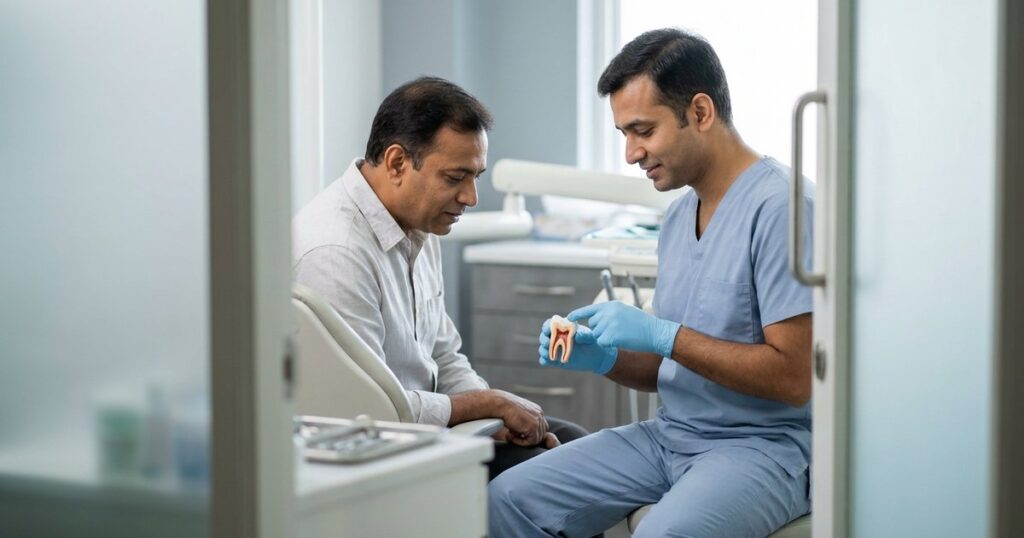
Root canal retreatment is a second attempt to disinfect and seal the inside of the tooth. We first assess the existing crown or filling and take suitable X-rays. If needed, further imaging helps us understand the shape of the roots and the surrounding bone.
During treatment, we reopen the tooth and remove the old filling material from the canals. We then look for missed canals, clean the canal system, disinfect it and seal it again. A surgical operating microscope can help us see small canals, cracks and other details that are difficult to see without magnification.
The tooth is isolated with a rubber dam, a protective sheet that keeps saliva away from the treatment area. Depending on the tooth and the work required, retreatment may take one or more appointments. After the canals are treated, the tooth needs a well-sealed restoration, often a crown, to reduce the risk of further leakage or fracture.
Some soreness around the tooth for a few days can occur after treatment. Healing around the root is usually assessed over time, rather than judged only by how the tooth feels the next morning. We may recommend a follow-up X-ray, including the yearly check X-ray used to monitor treated teeth.
Keep the natural tooth when it is healthy enough to repair and protect.
When is an apicoectomy considered?
An apicoectomy is a small endodontic surgery that treats infection at the apex, the tip of the root. We make a small opening in the gum and bone, remove the infected tissue and the end of the root, then seal the root from that direction.
This may be considered when infection remains around the root tip after a well-performed root canal, when the canal cannot be safely reopened, or when removing a post or crown could damage the tooth. A post is a support placed inside a treated tooth to help hold a restoration.
An apicoectomy is not a replacement for proper diagnosis. The choice between retreatment and surgery depends on the tooth’s anatomy, the existing restoration, the location of the infection and the amount of remaining tooth structure. We explain the expected steps, healing and alternatives before treatment.
After surgery, the gum may be tender or swollen for a short period. You may be asked to eat softer foods, keep the area clean as advised and avoid disturbing the surgical site. Healing of the gum is generally quicker than healing of the bone around the root, which is checked later with examination and imaging.
When may the tooth not be savable?
Some teeth cannot be predictably repaired. The most serious problem is often a vertical root fracture, a crack that extends along the length of the root. Bacteria can enter through the crack, and treating the canals again cannot close a fracture that continues through the root.
A tooth may also be unsuitable for saving if too much of the crown has broken away, if decay extends deeply below the gum, or if there is severe loss of the supporting bone. A tooth with a poor long-term outlook may cause repeated infection even after further treatment.
If removal is the safest option, we discuss what happens next. Replacement may involve an implant, bridge or another restoration, depending on your general health, the condition of the neighbouring teeth and the available bone. Extraction is a significant decision, so if you have been told that a tooth must be removed, a second opinion for a complex root canal can help clarify whether saving it is possible.
| Option | What it involves | When it may fit |
|---|---|---|
| Retreatment | The tooth is reopened, cleaned and sealed again. | A missed canal, leakage or persistent infection can be treated from inside. |
| Apicoectomy | Infected tissue and the root tip are treated through a small surgical opening. | The infection is at the root tip or the canal cannot be reopened safely. |
| Extraction and replacement | The tooth is removed and replaced if appropriate. | A fracture, severe decay or advanced loss of support makes saving the tooth unrealistic. |
What should you do now?
Do not chew hard foods on a painful treated tooth, especially if part of the crown or filling has broken. Keep the area clean, but do not place aspirin or other substances directly on the gum. Avoid delaying care simply because the pain has reduced, since an infection can remain active without strong symptoms.
Bring any previous X-rays, treatment records and information about when the pain or swelling began. Tell us whether the tooth hurts on biting, whether it feels high when you close your teeth, and whether you have noticed a gum boil, bad taste or loose filling.
Facial swelling, fever, difficulty swallowing or difficulty breathing requires immediate care. A knocked-out permanent tooth is also an emergency. Seek urgent dental or medical attention rather than waiting for a routine appointment.
The cost depends on the tooth and the work needed. We explain the cost after examining the tooth and reviewing the X-ray. The most useful next step is to arrange an examination with an endodontic specialist before agreeing to extraction, particularly when the tooth has already had a root canal or the diagnosis is uncertain.
Key takeaways
- Arrange an examination and X-ray if a treated tooth hurts, swells or feels tender again.
- Ask what caused the failure and whether retreatment or an apicoectomy can address that cause.
- Do not assume extraction is the only choice until the tooth has been assessed for cracks, remaining structure and bone support.
- Protect the tooth from hard chewing and seek immediate care for facial swelling, fever, or problems swallowing or breathing.
Questions patients ask
Can a failed root canal be painless?
Yes. Some infections around a treated tooth cause little or no pain and are found on an X-ray. A gum swelling, recurring pimple or change seen during a dental check can still need treatment.
Will retreatment be more painful than the first root canal?
Retreatment is performed with local anaesthesia, and we take steps to keep you comfortable. The tooth can be tender for a few days afterwards, but pain levels vary with the infection, the tooth and the procedure.
Can antibiotics cure a failed root canal?
Antibiotics may be used by a dentist or doctor in selected situations, such as spreading infection or systemic symptoms. They do not remove infected material from inside the canals, so dental treatment is usually needed to address the source.
How long should I wait before deciding whether treatment has worked?
Symptoms may settle before the bone around the root has fully healed. We assess healing clinically and with follow-up imaging over time, because one early symptom or X-ray cannot always show the final result.
Can I go straight to extraction if I am worried about another root canal?
You can discuss every option, but extraction is irreversible. If preserving the natural tooth matters to you, ask for an endodontic assessment before removal, especially when the reason for failure or the presence of a crack has not been confirmed.
Questions about your own tooth?
Send your details and X-rays on WhatsApp and the clinic will get back to you.